Friday, May 30, 2008
Observation #9 (the final one)
I was going to have the beaver pursuit be my last observation, but instead I decided to have one last one comparing my site from when I first started until now. There was still snow covering the ground during my first observation and now there is tons of vegetation that has completely taken over. Over this entire process, I have become more aware of the different species of birds and plants that are everywhere around Jackson. The amount of birds occupying my area was absolutely fascinating. The massive amounts of birds would just swoop out of nowhere in every direction. One thing that I realized I have neglected to mention throughout this entire project is that I have a terrible fear of birds. I have been attacked on multiple occasions by birds in neighborhood so over the years my fear of birds has continued to escalate. I was super proud of myself for persisting in my observations despite my terrible fear. Honestly, I thought that this project was going to be extremely boring, but it actually turned out to be rather interesting!

Observation #8 (the incredible beaver persuit!!)
Instead of doing my normal observation at my site, I decided to go on a quest for beavers. It was around 8:00 at night and 46 degrees. Luckily, the rain had subsided and there were only some clouds. I was very pessimistic at first because I thought there would be no way I would see a beaver dam let alone a beaver. Reluctantly, I drove down Fishe Creek Road and searched for beaver dams in the creek. As I was driving over a cattle guard, I swas this big pile of sticks on the side of the road. I honestly didn't think much of it other that it being a big pile that someone had discarded. As I continued on, I decided to turn around just to make sure that it was nothing more than a pile of sticks. I pulled off to the side of the road and went to investigate. Immeadiatly, I realized it was a beaver dam! Not only was there one beaver dam, but there were four! My assumption is that the four dams must have been the creation of one beaver family because I doubt there would be enough resources for multiple beaver populations. As I looked around, I became aware that all of the trees and willows had been completely gnawed down. It was absolutly incredible to witness the astonishing amount of work that the beavers must have put in to establish such complex dams. I was able to see how the beaver's dams were capable of slowing the water and creating a larger niche for themselves as well as other organisms. I examined the branches that the beavers had chewed down and I was able to see exactly where their teeth had sawed through the wood. Needing to get a closer look, I crept down towards the creek, careful not to disturb anything. As much as I had wanted to, I knew that I would probably not be able to see the actual beavers because they would be hiding away in their dams from the predator (me) that was lurking near thir home. I stood there for a while longer andall othe the sudden, I saw a little baby beaver swimming!!! The little beaver did not seem to mind me at all; it just swam around and did flips with it's large, flat tail following behind. It was so fascinating to watch this little baby beaver and then, another little one came out and joined it! They were so adorable, but I had to leave eventually so I returned home and left them in peace.
Observation #7
Today was a rainy day for the most part, but during my observation it was actually really nice. It was right as the sun was about to set behind the mountains around 7:26. I think that the thermometer in our car was temporarily broken because it said it was 50 degrees, but it felt more like 40 to me. There was a party going on with a whole bunch of really noisy kids taking place right near where my observation sight so the birds seemed to be hiding in their nests. They were not to scared though because as I sat there, they swooped out from the tops of trees to catch there food. I saw an abundance of yellow warblers flying from tree to tree. One even landed on a branch right near me until it noticed that I was right next to it and it flew away. I saw the male and female mallard ducks that I have seen on several other occasions. There were also a couple of birds that were blue, black, and white. While waiting for something interesting to happen, I saw a population of hummingbirds swarming around a tree. There were many other species of birds flying around, but I was unable to identify them because they flew to fast and they blended into the trees. The bugs were everywhere. They probably enjoyed the muggy air from the days of rain that we have had.
The flora at my observation site was flourishing. There is an abundance of dandelions and other species of weeds invading the are as well as several other types of plants. To my disappointment, the forget-me-nots have still neglected to bloom. There are countless forget-me-not bundles lining the stream, but none of them have a single flower on them. All of the willows have green leaves on them. Although it is still very early in the season, some even seem to be going to seed. I saw some moss growing on the bark of a tree which is new to my area. The larger trees such as the aspens have grown new, bright green leaves. All of the rich vegetation that is continuously emerging is making everything look more like summer!
The flora at my observation site was flourishing. There is an abundance of dandelions and other species of weeds invading the are as well as several other types of plants. To my disappointment, the forget-me-nots have still neglected to bloom. There are countless forget-me-not bundles lining the stream, but none of them have a single flower on them. All of the willows have green leaves on them. Although it is still very early in the season, some even seem to be going to seed. I saw some moss growing on the bark of a tree which is new to my area. The larger trees such as the aspens have grown new, bright green leaves. All of the rich vegetation that is continuously emerging is making everything look more like summer!
Wednesday, May 28, 2008
Flora Report
Shauna North
Ms. Overly
4th Hour
May 22, 2008
Ms. Overly
4th Hour
May 22, 2008
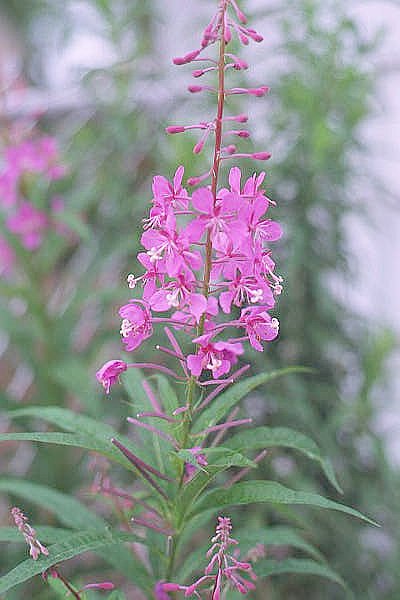
Fireweed
Fireweed, whose scientific name is Epilobium angustifolium is given its name because it is usually the first plant to establish itself after a fire. The fireweed is extremely important to the burnt ecosystem because it spreads easily and colonizes the primary community. Within a single year, fireweed is capable of taking over a completely charred area due to its rapidly spreading seeds.
The beautiful blossoms of the fireweed are magenta pink to purple. Each flower has four petals that are clustered in groups of over fifteen per stem. The flowers begin to bloom at the bottom of the steam and slowly work their way up to the top. The blooming occurs in June through September. The stem can grow anywhere from one to seven feet tall, is thick and has an abundance of leaves growing up it. The fruit of fireweed comes in the form of seed pods with 300-500 seeds in each. When the seed pod splits, it releases small, fluffy, white seeds. The large amounts of seeds that are dispersed by the wind promote the rapid production of fireweed. The primary conditions for the growth of fireweed are full sunlight or with slight shade and little to no water. These requirements are the reason why fireweed is so successful after a fire.
Fireweed is key to primary succession because it is the first organism to take over an area after a large disturbance such as a fire. It colonizes the community and encourages the growth of other plant life, helping the new community replace the old one. Another advantage of the fireweed is that it has many healing qualities such as healing a sore throat, reducing the itching of eczema, a pain reducer, and more. Like most organisms, with benefits come drawbacks. Although fireweed remedies can benefit humans, it is poisonous for certain animals including dogs. Fireweed is very competitive with other species because it is an aggressive weed that is capable of taking over fields and killing plants in its way. Not only does it take over ecosystems, but it destroys the soil by extracting nutrients from it.
The Fireweed is native to Alaska as well as many other places around the world. It is said by some Alaskans that when the fireweed begins to go to seed, there are six weeks left until winter. Although this fact is not scientifically proven, there are many myths about fireweeds that seem to be true.
Work Cited
Andreas Viclund. Beaver Looking. May 28, 2008. [http://dnr.state.il.us/orc/wildlife/virtual_news/images/beaver/beaver_looking_camera.jpg]
Beaver- Castor candensis. 2008. Nature Works. May, 28, 2008. [http://www.nhptv.org/Natureworks/beaver.htm]
Don. Fireweed. May 28, 2008. [http://www.dontveter.com/howtogrow/fireweed2000.jpg]
Mathews, Daniel. Rocky Mountain Natural History. Canada, Altitude Publishing,2003.
Shaw, Richard. Plants of Yellowstone and Grand Teton National Parks. Salt Lake City, Utah: Wheelwright Press, 1981
The Beaver. 2002. Beavers: Wetlands and Wildlife. May 28, 2008. [http://www.beaversww.org/index.html]
Thursday, May 22, 2008
Observation #6
Yesterday, May 21 at 4:10pm, it was pouring rain. Not only was it raining but it was a chilly 38 degrees. Although I was not to enthused with the weather, the birds absolutely LOVED it! The rain brought out lots of worms and other creatures that intrigued birds of all kind because they were flying around everywhere. There were loads of different species of birds such as ones with red heads, yellow ones, robins, and much more. It seemed as though they also enjoyed the rain because they could stay cool and rinse off. I wish I could identify all of the birds, but that seems like an almost impossible task. Because of the rain I was using an umbrella so it muted the sound of the birds somewhat. It was absolutely infeasible for me to attempt to hold an umbrella over my head and and try to take notes all with one hand so I was forced to close the umbrella and get very wet. As I closed the umbrella, I was overwhelmed by all of the different songs sung by all of the diverse species of birds. I have never heard so many birds chirping at once. Whatever was brought out by the rain, the birds sure loved to eat it because they were all consuming whatever it was. The birds would latch on to tiny branches that did not seem capable of supporting there weight and they would snatch food into their beaks from the water. During the spring and summer months, I usually only see humming birds congregating around humming bird feeders and never in their natural habitat. Although, the rain seemed to bring them out from hiding as well. I saw this weird looking bird that just seemed to be hovering and flying backwards. It wasn't that windy, so the wind could not have been pushing it back and from previous knowledge, I knew that hummingbirds are the only birds that can fly backwards. So, I was able to determine it was a hummingbird. It was the biggest hummingbird I have ever seen. I saw several more normal-sized hummingbirds and a slew of other types of birds and by then I was freezing cold and totally drenched so I decided to leave. If the weather improves by my next observation, I plan to go on an adventure down Fish Creek to see if I will be able to find evidence of beavers beginning their dams.
Wednesday, May 21, 2008
Observation #5
Today was a mild day. It was cloudy, but it was still 68 degrees. Looking at the sky, it looks as if it is going to rain. It was around 6:00pm on Tuesday, May 20. Usually I see tons of birds swarming the sky, but today they were not flying around as much as they normally do. I know they were still around because I could hear them all chirping, but they were not flying about like crazy. I predict that this is because somebody was in my area before me and created a disturbance that scared them away. That or they were taking shelter from a storm that was about to take place. I sat there for a while, waiting for the birds to come out of hiding when I saw a couple of butterflies. They were not colorful like most butterflies, they were white and very fast. I looked and looked for something interesting and I saw a bird in a little swampy island eating something. Then I saw two mallard ducks (a male and a female) floating down the stream. The beginning of the big nest that I saw in my previous observation was considerably bigger. I could not see the birds that live in it, but I will hopefully get to see the little chicks that will hatch in the near future. That was the extent of the fauna that I saw in this observation.
Unfortunately, the forget-me-nots did not bloom as I had hoped they would. They had just spread down the stream bank. There were a whole bunch dandelions that had grown though. The willows that take up my entire area have grown even bigger green blooms. On some of them they even have fuzzy things with yellow tips. As I was driving to my site, I noticed that flat creek, fish creek, and the snake river were all super full and murky due to the run off. I expected for my wetland to be very full and swampy everywhere and murky as well, but it was not. The water level had slightly risen, but it was not murky at all what-so-ever. This is probably because the water in wetlands are purified. Hopefully that in my next observation there will be more changes that will be really interesting.
Unfortunately, the forget-me-nots did not bloom as I had hoped they would. They had just spread down the stream bank. There were a whole bunch dandelions that had grown though. The willows that take up my entire area have grown even bigger green blooms. On some of them they even have fuzzy things with yellow tips. As I was driving to my site, I noticed that flat creek, fish creek, and the snake river were all super full and murky due to the run off. I expected for my wetland to be very full and swampy everywhere and murky as well, but it was not. The water level had slightly risen, but it was not murky at all what-so-ever. This is probably because the water in wetlands are purified. Hopefully that in my next observation there will be more changes that will be really interesting.
Monday, May 19, 2008
Beaver Report

Shauna North
Ms. Overly
Science Pd.4
May 19, 2008
The Beaver
Ms. Overly
Science Pd.4
May 19, 2008
The Beaver
The Beaver
Beavers are gentle organisms whose scientific name is Castor Candensis. Beavers are a keystone species because without them, the entire ecosystem around them will die. Beavers construct a rich habitat for many members in its community including fish, turtles, frogs, mammal, and ducks. By damming up streams, beavers create wetlands, providing other organisms with a home filled with rich vegetation and shelter. In America, nearly half of all endangered species depend on wetlands for survival. This is another reason why the survival of the beaver is crucial to the survival of other organisms that rely upon wetlands. In addition to creating wetlands, beavers maintain them by preventing erosion, raising the water table, and purifying the water.
Mature male and female beavers mate for life. Once the parents have successfully built an adequate dam for themselves, the female begins creating a comfortable, soft area for their young. Mother beavers give birth to their kits once every year during the spring months. Within 24 hours after birth, the young kits are able to swim and explore the waters with their parents. Some of the adaptations that the beaver has obtained are its webbed feet to help propel them through the water, fir coated with castoreum oil that prevents the freezing water from reaching its skin, a large tail that helps keep them balanced while chopping down trees, and huge teeth that enable them to chop down trees to build their dams. The beaver is also equipped with anti-predator adaptations. When a beaver senses danger, it signals fellow beavers by slapping its tail against the water, warning them that there is a predator. Most of these traits are instinctive although some are learned.
The kits live with their parents until they are mating age, around three years old. Until that time, the kits are cared for by both their mother and their father. Adult beavers are capable of growing to over 60 pounds and more than four feet in length. Some beavers can live up to 20 years of age.
Beavers work hard throughout the year by pruning trees and maintaining their dams. Incidentally, the pruning stimulates the growth of the willows, aspens, and cottonwoods. The dams that they build offer them protection from predators and a safe place for them to reside during the winter months. Instead of having to live through cold, harsh winters, the beavers survive in their warm, sheltered dams that are stocked with plenty of food for the winter. The beavers live in colonies of six that usually consist of the parent, the yearlings, and the kits. They dwell peacefully in their dams for the winter ends.
The beaver has both a positive and a negative effect on the environment. They create wetlands which provide a prime environment for many organisms. The stagnant water is rich in nutrients that’s key to the growth of trees and other plants that supply birds and other animals with shelter. The down-side of the beaver’s residence is that they can cause the silt to build up and destroy certain animal’s habitat. The damming also can cause floods in low-lying areas. When I used to live on Fish Creek Road, the beavers would dam up the creek and cause our house to flood. The survival of beavers is vital to the success of many different organisms and their environment.
http://www.beaversww.org/beaver.html
http://www.nhptv.org/natureworks/beaver.htm
http://dnr.state.il.us/orc/wildlife/virtual_news/images/beaver/beaver_looking_camera.jpg

Friday, May 16, 2008
Observations #4
Today I started my observation early in the morning around 6:45 in hopes that the different time of day would allow for me to see different biodiversity. It was about 40 degrees and I thought that the cooler temperature would bring more species of birds out from there nests. The phrase "The early bird gets the worm" must be a religion for the birds in my area because there were massive amounts of birds flying around eating whatever that could get their little beaks around. Again, I was able to witness the birds swooping from the sky and snatching all types of large insects from the air. Lucky for me though, there were not as many bugs out as the previous days probably due to the cooler temperature. I am positive that I have not seen all of the different populations of birds that reside in my area. I know this because I hear about ten or more diverse types of chirps coming from the dense willows. Following up on my prediction in my second observation, I was correct. The green grass has almost completely taken over the dead grass from last season. The ecosystem seems to be lacking in abiotic factors. There are very few rocks and everything else seems to be full of life. The forget-me-nots that I talked about in my previous observation are growing like mad and are taking up the marshy area near the stream. I predict that in about a week or two, the forget-me-nots will be in full bloom. I still proved unsuccessful in my attempt to see the moose that continues to chew off the tops of the willows. This morning I also saw a butterfly. It was the first one I have seen since last summer. I believe that it was using camouflage as it's anti-predator adaptation because it was orange-ish and black which blends in almost completely with the color of the willows. Soon, I anticipate to start to spot some frogs and/or fish in the marshy stream. Well, I have to go spend the rest of this gorgeous day in school so.....
Thursday, May 15, 2008
Observation #3
Today was an extraordinary day! It was an amazing 65 degrees at around 5:00pm and only slightly breezy. First off, I noticed that there weren't nearly as many birds as there were on my last visit. The only predictions that I make as to why this happened is because it could of been too hot or because they were off doing something else. Although there were not as many birds, there were still plenty for me to watch. Immediately upon my arrival I saw a large bird carrying a branch to the nest that it was constructing. The nest was craft fully put together in a willow tree. Speaking of willows, the green buds on the willows that I found in my last observation had morphed into green, fuzzy things. I continued to observe the vegetation that is rapidly changing in everyone of my visits, and I saw many forget-me-not flowers starting to grow along the wetlands. The soil that is rich in nutrients helps specially adapted plants such as the forget-me-not grow. I investigated in the willows for a while and realized that a moose had recently been there because it had eaten the tops of the willows. My hope is that I will be able to catch the moose that I keep seeing signs of during one of my future observations. I migrated towards the water and there were copious amounts of the bugs that skim along the surface of the water. I searched and searched by I was unable to spot a fish. I thought that with the stagnant water and the plentiful amounts of bugs that the fish would be out in full force. Apparently not. Maybe it is too early in the season for them or the do not like the water that I am studying. As for the bugs that fly around, they were getting gobbled up by birds like kids in a candy-store. I would look up and see a bug in the air and all of the sudden, a bird would come from nowhere and snatch the bug into its beak with impressive skill. I also saw birds (mainly King Fishers) feasting on the bright green allege. This all reminded me of how the food web works. The bugs eat little particles in the water and leaves, the birds eat the bugs and the allege, fish eat the allege, big birds eat the fish, and so on. I was lucky enough to see the bright yellow bird again today and I think it is probably a yellow warbler. Despite the gorgeous day it was outside, I had to get home, but as I was leaving I saw the weird fuzzing things that come off of the aspen trees. From my previous knowledge, I know that these turn purple-ish when they get wet and after a while they turn into a cotton-like substance which I might add that I am highly allergic to. I believe that this is the aspen's way of spreading it's seeds in order for it to reproduce.
Tuesday, May 13, 2008
Observation #2
On my second observation, the thin layer of snow that covered the area in my first observation was melted and I was able to sit and observe all of the interesting things that took place around me. The first thing I noticed when I arrived was a pile of fresh moose scat that was not there the last time I visited the area. There was also some other scat that I was unable to identify(for all I know, it could have belonged to a dog). As I navigated through the dense willow towards the water, I was suddenly inundated with hundreds of bugs (probably mosquitoes) swarming my head. While I was pushing away branches, I noticed that all of the willows had green buds on them that leads me to believe that they will eventually bloom into something. There was also new green grass sprouting up from underneath the old grass that I am assuming will eventually completely take over the dead grass in the near future. I was able to witness two ducks on a little grassy island in the middle of the creek before I accidentally scared them and they flew off making honking noises. Since I had arrived, I had been hearing what seemed like hundreds of different species of birds chirping away. It was like being in a giant bird store! I tried to meander my way around the trees along the creek to find something interesting, but all it seemed like I was doing was disturbing all of the birds. After relentless attempts at trying to catch a glimpse of something really cool, I resorted to just sitting and observing which proved to be way more interesting than I had thought it would have been. By sitting and watching I was able to see some of the most amazing birds I have ever seen in my entire life. At first I only saw lots of little gray birds, but as I looked closer I started to see birds that were all black with a bright yellow stripe around there chest. I saw several black birds and robins and all of the sudden, I saw this BRIGHT, BRIGHT blue bird. It was bluer than any bird I have ever seen. Looking closer at it I saw what I thought was a piece the yellow caution tape that police use at crime scenes, but it turned out to be an almost neon yellow colored bird! They looked like parakeets they were so bright. I continued to listen to the amazing variety of bird chirps for a little while longer and I was able to distinguish the clicking-like sound of a wood-pecker. Just as I was leaving, I saw several beginnings of bird nests that I will continue to monitor the progress of throughout my further observations.
Today, May 13, was a beautiful day with only one tiny cloud in the sky that I could see. I began my observation at 5:26pm. It was a decent 54 degrees and there was little to no wind.
Today, May 13, was a beautiful day with only one tiny cloud in the sky that I could see. I began my observation at 5:26pm. It was a decent 54 degrees and there was little to no wind.
Sunday, May 11, 2008
Observation #1
My area is a wetland behind the post office in Wilson. A wetland is a land transitional between terristial and aquatic systems where the water table is usually at or near the surface or where shallow water covers the land. Wetlands can also be refered to as marshes or swamps. Many types of organisms congregate around the wentlands including bevers, populations of birds, moose, muscrats, and much more. The moist soil also offers a prime place for all types of vegitation to thrive. I chose this area because I thought it would provide me with plenty of interesting ecology things to study!
In my observation today, May 10, it had just snowed the previous night so there was a light dusting of snow covering the ground. I visited my location at around 9:30am and it was 40 degrees. It was a fair day although it was slightly breezy, rather cold, and cloudy. The soil was frozen and covered in snow, but the soil in the area that I cleared of snow was very moist and swampy. In fact, the bottoms of my pants and my shoes were completly soaking by the time I had finished. I hypothisize that by my next observation, I will be able to see more signs of flowers begining to grow and blossum.
From previous knoledge and from my observations, I know that some of the plants that grow in my area include willows, pine trees, bog orchids, forget-me-nots, and lots of other vegitation that I was unable to identify. Some of the birds that I know that live in the area are a great blue heron, golden egles, yellow warblers, ducks, and robins. I saw and heared tons of birds flying around and fighting eachother for food. I think it was still to cold outside to see any fish, ducks, or other animals. I have decided to further study the beaver and the bog orchid.
Subscribe to:
Posts (Atom)